


Silicone Foams
What Is Silicone Foams
Silicone foam is a type of rubber material that is made by combining silicone with other chemicals to create a foam-like texture. This material is known for its unique physical properties, including high temperature resistance, excellent electrical insulation, and strong chemical resistance. These properties make it an ideal material for use in various industries such as automotive, aerospace, construction, and electronics.
Advantages of Silicone Foams
Excellent Cushioning: Silicone Foams provides exceptional cushioning properties, offering enhanced protection against impact, vibrations, and shocks. It helps minimize the risk of damage to sensitive equipment or delicate components.
Superior Insulation: Silicone Foams exhibits excellent thermal insulation properties, making it suitable for applications where temperature control is critical. It can withstand extreme temperatures, both high and low, without compromising its performance.
Versatile and Flexible: Silicone Foams tubing is highly flexible, allowing for easy installation, bending, and shaping. Its versatility enables it to fit various shapes, sizes, and contours, making it suitable for a wide range of applications.
Moisture and Chemical Resistance: Silicone Foams tubing is highly resistant to moisture, water, and many chemicals, making it ideal for applications in wet or corrosive environments. It maintains its integrity and performance even when exposed to harsh conditions, such as chemicals, oils, solvents, or UV radiation.
Noise and Vibration Damping: The cushioning properties of Silicone Foams help absorb and dampen noise and vibrations, making it beneficial in applications that require noise reduction or vibration isolation, such as automotive, industrial, or HVAC systems.
Long-lasting Durability: Silicone Foams is known for its durability and longevity. It has excellent resistance to aging, weathering, and degradation, ensuring its performance and functionality over an extended period. It is also resistant to cracking, tearing, and compression set, maintaining its shape and properties even with frequent use.


Why Choose Us
Professional Team
We have a team of skilled and experienced professionals who are well-versed in the latest technology and industry standards. Our team is dedicated to ensuring that our customers get the best service and support possible.
Quality Control
All goods will undergo strict quality inspection before shipment. always insists on providing high-quality products. We firmly believe that quality is the basis of everything.
One Stop Solution
From the begining inquiry and throughout the entire process until you receive the goods. we are dedicated to supporting you every step of the way.
Quality Products
We use only the highest-grade materials and advanced manufacturing techniques to produce products that are reliable, durable, and perform to the highest standards.
Competitive Price
We have professional sourcing team and cost accounting team, stive to reduce cost and profit and provide you a good price.
Sustainable Development
Establish a good reputation and brand value in the industry, and promote the sustainable, stable, rapid and healthy development of the enterprise.

Silicone foam is a versatile material used in various applications due to its unique properties. There are different types of silicone foam, each with specific characteristics that make them suitable for certain purposes. One type is the closed-cell silicone foam, which has a tight cell structure and provides excellent thermal insulation, making it ideal for use in high-temperature applications such as electronics and automotive industries.
Another type is the open-cell silicone foam, which has a porous structure that allows air to pass through freely. It is commonly used in acoustic insulation due to its sound-absorbing properties. Its ability to absorb vibrations also makes it useful in cushioning applications such as padding for sports equipment or furniture.
Finally, there is the flame-retardant silicone foam tube designed for applications where fire resistance is crucial. This type of foam releases very little smoke when burnt and does not produce toxic gases, making it ideal for use in public buildings such as schools and hospitals.
Silicone foam possesses several remarkable characteristics that make it highly desirable for various industries. One of its key properties is its exceptional thermal stability. Silicone foam can withstand extreme temperatures ranging from -60°C to 250°C, making it suitable for applications where resistance to heat is essential, such as in insulation materials for aerospace and automotive industries.
In addition to its thermal stability, silicone foam also exhibits excellent flame retardancy. This property makes it an ideal choice for applications requiring fire-resistant materials, including construction, transportation, and electronics. The self-extinguishing nature of silicone foam ensures safety and reduces the risk of fire propagation.
Furthermore, silicone foam demonstrates remarkable resistance to chemicals, oils, and solvents. It remains unaffected by exposure to harsh substances, making it suitable for gaskets, seals, and encapsulation in chemical processing plants, refrigeration systems, and other industrial settings. Its resistance to degradation by UV radiation also makes it a durable option for outdoor applications.

Silicone Foam Chemical Properties
|
Mechanical Properties |
Metric |
English |
|
Hardness, Shore A |
3.0 - 62 |
3.0 - 62 |
|
Hardness, Shore OO |
40 - 70 |
40 - 70 |
|
Tensile Strength, Ultimate |
0.0552 - 2.80 MPa |
8.00 - 406 psi |
|
Tensile Strength, Yield |
0.172 - 1.24 MPa |
25.0 - 180 psi |
|
Elongation at Break |
49 - 300 % |
49 - 300 % |
|
Compressive Yield Strength |
0.00800 - 0.170 MPa |
1.16 - 24.7 psi |
|
Compression Set |
0.00 - 80 % |
0.00 - 80 % |
What’s The Difference Silicone Foams And Silicone Sponge
Silicone foam and silicone sponge are both versatile materials used in various industries, They are two different materials with distinct properties. Here's how they differ:
Silicone foam is typically composed of silicone rubber and a blowing agent, which creates gas bubbles or cells in the material. This results in a more open-cell structure, similar to regular foam materials like polyurethane foam and has interconnected air pockets that allow for airflow and compression. On the other hand, silicone sponge is made by incorporating a filler material into the silicone rubber, creating a closed-cell structure, meaning its cells are sealed off from each other.
Silicone foam generally has a lower density and is softer compared to silicone sponge. It is more compressible and offers better cushioning and shock absorption properties and will quickly recover its shape when pressure is released. Silicone sponge, being denser and more rigid, provides higher compression strength and is better suited for applications requiring stability and resistance to deformation.
Due to their differing structures, silicone foam and silicone sponge have different thermal insulation properties. Silicone foam, with its open-cell structure, allows air circulation within the material, making it a better thermal insulator. Silicone sponge, with its closed-cell structure, offers less thermal insulation but provides superior resistance to heat transfer - it has a higher compressive strength and slower recovery rate.
Silicone foam has higher water absorption capabilities due to its open-cell structure, which can be advantageous in certain applications, such as sealing against moisture or creating water-resistant barriers. Silicone sponge, with its closed-cell structure, has lower water absorption properties.
Both silicone foam and silicone sponge find applications in various fields. Silicone foam is commonly used in cushioning, padding, and vibration dampening applications. Silicone sponge is often utilised for sealing, gap filling, insulation, gaskets, thermal management applications and other applications requiring a reliable barrier against external elements. It provides a reliable seal against dust, air, water, and other environmental elements. Silicone foam, with its open-cell structure, is not ideal for sealing purposes as it allows for permeability.
What Is Silicone Foam Used For


Uses In Buildings
Silicone foam is a versatile material that has various applications in the building industry. One of its primary uses is as an insulation material for buildings. Silicone foam sheets are installed within walls, ceilings, and floors to prevent heat loss or gain, thereby improving the energy efficiency of the building. It also helps in reducing noise transmission between rooms. Another use of silicone foam in buildings is as a sealant.
Its superior sealing properties make it ideal for filling gaps around windows, doors, and other openings to prevent air and water leakage.This not only improves the energy efficiency but also protects against moisture damage. Silicone foam is also used as a fire retardant material due to its high-temperature resistance properties. In case of fire outbreaks, it can help delay or stop the spread of flames by creating a barrier between two spaces.
Uses In Healthcare
Silicone foam is a versatile material with numerous applications in healthcare. One of its most common uses is as a wound dressing. The foam's soft, pliable texture conforms to the shape of the wound, providing cushioning and protection against further injury or infection. It also absorbs excess fluid and promotes healing by maintaining a moist environment around the wound. In addition to wound care, silicone foam is also used in prosthetics and orthotics.
Its lightweight yet durable properties make it an ideal choice for creating custom-fitted prosthetic limbs that are comfortable for patients to wear over extended periods of time. It can also be used as padding inside braces or supportive devices to help distribute pressure evenly and reduce discomfort. Another application of silicone foam in healthcare is in medical imaging equipment such as ultrasound machines. The material's acoustic properties allow it to transmit sound waves effectively while minimizing interference from other materials or structures in the body, resulting in clearer and more accurate images for diagnosis and treatment planning.
Uses In Automotive Industry
Silicone foam is increasingly being used in the automotive industry due to its unique properties. It has excellent resistance to temperature, chemicals and UV radiation. With these characteristics, silicone foam can be used for various applications such as sealing, vibration dampening and insulation. One of the main uses of silicone foam in the automotive industry is to reduce noise levels inside vehicles.
The foam's ability to absorb sound waves makes it an ideal material for sound-deadening applications. Additionally, it can also be used to reduce vibrations caused by engine components or road conditions. Another application of silicone foam in the automotive industry is as a gasket material. Silicone foam gaskets are highly resistant to heat and chemicals, making them suitable for use in high-temperature environments such as engines and exhaust systems. They also provide a reliable seal that prevents leaks while withstanding pressure changes caused by thermal expansion and contraction.
The usefulness of silicone foam stems from its unique porous structure and material propertie.
Tiny air bubbles dispersed throughout the silicone create voids that provide softness and springiness. This gives foam better cushioning than solid rubber.
Open-cell foam has interconnected bubbles so air permeates easily. Closed-cell has isolated bubbles, preventing airflow. Open-cell works better for cushioning, closed-cell for flotation and insulation.
Viscoelasticity causes silicone to slowly rebound after compression rather than immediately springing back. This provides shock absorption.
Low density coupled with elasticity provides excellent energy absorption for impact protection. Lightweight foams withstand high pressures without compacting fully.
Water resistance makes silicone foam buoyant and insensitive to moisture. Closed-cell foam will float indefinitely.
Thermal stability allows silicone foam to withstand high and low temperature extremes without breaking down.
Silicone Foams Production Process
Silicone Foams needs to go through a series of production processes, processing technology, each link will have an impact on the finished silicone foam.
Plasticizing (that is, the plasticity of the raw rubber refining. That is, no additives in the open refining machine refining. Let the rubber soften to melt into the cooperating agent (to prepare for mixing).
The essence of plastic refining of raw rubber is to break and destroy the macromolecular chain of rubber, improve the plasticity of rubber, and make the mixing and blending of the compound easier. In the production of foamed rubber products, raw rubber is fully plasticized, will make the rubber plasticity better, easier to make the bubble hole uniformity, low density, small shrinkage products.
Mixing, That Is, The Plasticized Rubber To Add a Variety Of Agents (Additives) For Refining.
Mixing process is a variety of agents in the raw rubber (or plasticizing rubber) in the process of uniform dispersion. As with the mixing of other polymer materials, in order to make the compatibilizer uniformly mixed in the raw rubber, must use the strong mechanical action of the refining machine. However, because the rubber compound has more components of cooperating agents, the morphological properties of cooperating agents vary greatly, and the influence of cooperating agents on the mixing process, the degree of dispersion, and the structure of the rubber compound is also very great, so the mixing process of rubber is relatively more complicated than that of other polymer materials.
The mixing process has a very important effect on the performance of the rubber material. Mixing is not good, the rubber will be uneven dispersion of compatibilizer, plasticity of the rubber is too high or too low, burning, frost and other phenomena, which will not only make the calendering, pressing, molding and vulcanization process can not be carried out normally, but also lead to the performance of the finished product degradation, and may even cause the product of the early end of life. Therefore, mixing is one of the important processes in rubber processing.
Parking
Rubber in the mixing is completed, must be placed for an appropriate period of time, so that a variety of additives in the mixing of rubber fully dispersed, rubber additives dispersed more evenly, the stability of the product size, the degree of smoothness of the surface, the degree of uniformity of the bubbles is also the better.
Temperature
Rubber foam is very sensitive to temperature, the same kind of rubber, foaming effect is not the same at different temperatures, because the foaming system and vulcanization system is sensitive to the temperature of different degrees, the system changes, the matching degree of difference, the effect is also different.
Molding
Foamed rubber products subsequent processing and molding methods are extrusion molding, molding, plate molding, etc., in accordance with the required structure of the finished product, specifications, length, size, shape, hardness, color is different, as well as the special needs of the drawings, you can carry out non-standard personalized customization.
Certifications
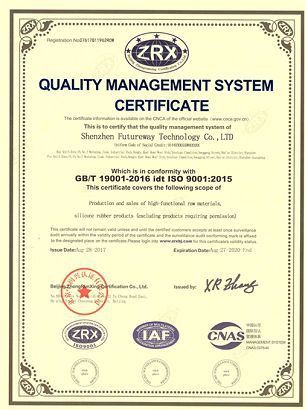


Our Factory
Futureway is a private material enterprise founded in 2010 by several experts from world's top 500 material companies. The company is committed to breaking through the technical and application barriers in the field of high-tech materials, focusing on the building and application development of the technology platform of fluoropolymers and silicone materials.

FAQ
Q: How is silicon foam made?
Q: What is the difference between silicone and polyurethane foam?
Q: What is silicone foam used for?
Q: What are silicone sponges made of?
Q: What are the benefits of silicone foam?
Q: What are the benefits of using silicone?
Q: Is silicone foam waterproof?
Q: What are 3 of the best qualities of silicone?
Q: How do you clean silicone foam?
Q: What is the difference between neoprene foam and silicone foam?
Q: Which is better neoprene or silicone?
Q: Is silicone foam oil resistant?
Q: What is the Young's modulus of silicone foam?
Q: Is silicone foam flammable?
Q: What is the conductivity of silicone foam?
Q: What are the applications of silicone foam?
Q: What is the mechanism of silicone foam?
As one of the most professional silicone foams manufacturers and suppliers in China, we're featured by quality products and competitive price. If you're going to wholesale customized silicone foams made in China, welcome to get quotation from our factory.
Lithium Battery Insulation Pad, Silicone Rubber Thermal Insulation Pad, Electrically Conductive Silicones For EMI Shielding